A breakdown of significant nonfiction works that officially entered the public domain on January 1, 2026 (following the expiration of their 95-year copyright term for works published in 1930):
Major 1930 Nonfiction Now in the Public Domain
• Sigmund Freud – Civilization and Its Discontents
Perhaps the most famous entry this year, this foundational text in psychology explores the tension between human instincts and the restrictions of a civilized society.
• Bertrand Russell – The Conquest of Happiness
A celebrated work of philosophy and early "self-help," where the Nobel laureate breaks down the causes of modern unhappiness and provides rational solutions for a better life.
• Sir James Jeans – The Mysterious Universe
A massive bestseller in its day, this book popularized the complex physics of the early 20th century, including relativity and the expanding universe, for the average reader.
• William Empson – Seven Types of Ambiguity
A cornerstone of modern literary criticism. It revolutionized how we read by identifying the different ways language can hold multiple, often conflicting, meanings.
• Ronald Fisher – The Genetical Theory of Natural Selection
A scientific powerhouse that unified Darwin’s theories with genetics. It remains a primary reference point for evolutionary biology.
• Siegfried Sassoon – Memoirs of an Infantry Officer
While semi-fictionalized, this is widely regarded as one of the most honest and haunting nonfiction accounts of the British experience during the First World War.
• Francis Yeats-Brown – The Lives of a Bengal Lancer
A definitive autobiography of the colonial era, detailing the author's military service and spiritual journey in India.
Why These Books Are "Digital Gold" in 2026
At the recent Digital Book World 2026 conference, these specific titles were highlighted for their new commercial potential. Since they are now free from royalty obligations:
• AI Training: Developers are using these high-quality, human-edited texts to fine-tune AI models on complex philosophical and scientific logic.
• Instant Audiobooks: Platforms are using synthetic "vintage" voices to release high-production-value audio versions of these classics for a fraction of the traditional cost.
• Interactive Editions: Educational publishers are "remixing" these texts into interactive apps, adding AI-generated summaries and quizzes for students.
In the United Kingdom, copyright law differs significantly from the US. Instead of the 95-year rule, the UK generally uses the Life + 70 years rule.
Because we are in 2026, works by any author who died in 1955 have officially entered the public domain in the UK. This includes a massive range of global intellectual heavyweights whose non-fiction works are now free to adapt, digitize, and publish.
Major Nonfiction Entering UK Public Domain in 2026
• Albert Einstein
Almost all of Einstein’s scientific papers and personal essays are now public domain in the UK. This includes his groundbreaking thoughts on relativity, physics, and his later-life philosophical reflections.
• Alexander Fleming
The writings and research papers of the Nobel Prize-winning biologist who discovered penicillin. His documented work is now a free resource for historians and science publishers.
• Thomas Mann
While famous for fiction, the German Nobel laureate’s extensive political essays and cultural critiques (written during his exile from Nazi Germany) are now free for UK publication.
• Dale Carnegie – How to Win Friends and Influence People
Carnegie died in 1955, meaning his seminal works on self-improvement and interpersonal skills are now public domain in the UK. (Note: His family/estate may still hold certain trademarks on the brand name, but the text of the original books is free).
• Jim Corbett – My India and The Temple Tiger
The legendary hunter-turned-conservationist died in 1955. His non-fiction memoirs about tracking man-eaters and his early efforts in wildlife preservation are now free to be reissued in the UK.
• Teilhard de Chardin – The Phenomenon of Man
The French Jesuit priest and philosopher also died in 1955. His deeply influential works combining evolutionary theory with spirituality are now in the public domain.
• Clemence Housman
A noted British author and wood engraver; her activist writings and historical research works entered the public domain this month.
Key Difference: UK vs. US Public Domain
It is important to note the "Copyright Gap" that was discussed at Digital Book World this year:
• In the UK: A book becomes free 70 years after the author dies, regardless of when it was published.
• In the US: A book becomes free 95 years after the publication date, regardless of when the author died.
• The Result: This creates a strange situation where a book might be free to publish as an ebook in London but still "protected" and illegal to sell in New York (or vice versa).
Why 1955 is a "Golden Year" for UK Publishers
The death of Einstein and Fleming in 1955 makes 2026 a massive year for educational and scientific publishers in the UK. Many are already using these texts as high-quality, free "training data" for specialized scientific AI models or releasing commemorative digital archives of their original notes.
The presentations at Digital Book World 2026 reflected a major industry pivot: moving away from "AI as a toy" to "AI as an infrastructure." The sessions were designed to help publishers navigate a world where discovery, production, and distribution have all been fundamentally altered by generative technology.
Here are the details on the key sessions and presentation tracks:
1. Keynote: The State of the Digital Book
The opening keynote, often featuring industry leaders from organizations like the National Book Foundation or Audible, focused on the "Post-Search Era."
• Core Argument: As AI chatbots (like ChatGPT and Claude) become the primary way people find information, publishers must shift from SEO (Search Engine Optimization) to AIO (AI Optimization).
• Takeaway: Presentations detailed how to structure "clean" metadata and high-quality "training-ready" data so that AI models accurately recommend and cite specific books.
2. Track: Marketing Book World
One of the most attended tracks, this focused on reaching readers in a fragmented digital landscape.
• "Agentic Marketing" Workflows: Demonstrations on using AI "agents" that don't just write copy but autonomously manage ad spends on Amazon and Meta, adjusting budgets based on real-time hourly sales data.
• Micro-Influencer Automation: Strategies for identifying and reaching thousands of niche TikTok and Instagram creators simultaneously using AI-driven outreach tools.
3. Track: Data Book World
This track turned technical, focusing on the math behind the modern bestseller.
• Predictive Acquisition: Data scientists from the "Big Five" presented on using AI to analyze historical sales data alongside social media trends to predict whether a manuscript will be a hit before the publisher signs the author.
• Global Rights Arbitrage: Using data to identify which foreign markets are currently underserved in specific genres (e.g., "Cozy Fantasy" in the Spanish-speaking market) to optimize translation investments.
4. Track: AI & Production Book World
This was the "hands-on" section of the conference, showcasing tools currently in use:
• Synthetic Voice 2.0: Presentations on "hybrid audiobooks," where a human narrator records the primary "emotional" beats of a book, while an AI clone of their voice handles the more straightforward narrative sections to cut costs by 40%.
• Automated Pagination & Design: Demonstrations of AI tools that can instantly re-format a 400-page manuscript into print-ready layouts for various trim sizes, including accessibility-focused versions for visually impaired readers.
Special Event: The DBW Author Conference
For the first time at this scale, a specialized track programmed by Jane Friedman focused on the "Solopreneur Author."
• The "Human-Only" Premium: A popular presentation on how authors can market their work as "100% Human-Created" as a luxury brand in a market flooded with cheap AI-generated content.
• Direct-to-Consumer (D2C) Mastery: Moving away from Amazon dependency by using platforms like Shopify and Substack to own the customer relationship.
The AI Ethics in Editorial panel at Digital Book World 2026 was a standout session that brought together legal experts, veteran editors, and tech ethicists to discuss the "Human-Verified" movement.
While the full roster for every breakout session is extensive, here are the key figures who led the core discussions on AI and Ethics during the January event:
Featured Panelists & Speakers
• Jane Friedman: As a leading industry consultant and author of The Business of Being a Writer, Friedman played a central role in the ethics discussions. She focused on Author Rights in the Age of Scrapers, specifically how creators can protect their style and intellectual property from being "mimicked" by generative models.
• Bradley Metrock: The CEO of Score Publishing and host of DBW, Metrock moderated several high-level panels on Operational Ethics. His sessions addressed the transparency requirements for publishers using synthetic voices in audiobooks.
• Ethan Mollick (Invited Expert/Contributor): Though often associated with broader AI education, his research on "Co-intelligence" was a primary reference point for the panel's discussion on how editors can use AI as a "sparring partner" without losing their unique editorial voice.
• Legal Counsel from the Authors Guild: Representatives from the Guild participated to discuss the 2025 AI Action Plan impacts and the new licensing frameworks that allow publishers to monetize their backlists for AI training while ensuring authors get a "fair share" of the royalties.
Key Discussion Points
The presentations were structured around three "Ethical Pillars":
1. The "Human-Verified" Label: Speakers debated the creation of a standardized industry badge (similar to "Organic" or "Fair Trade") that certifies a book has undergone a specific level of human editorial oversight.
2. Bias in Triage: A technical presentation explored how "Slush Pile AI" (used to screen manuscripts) can inherit human biases, and how publishers must audit these tools to ensure diverse voices aren't filtered out by algorithms.
3. Synthetic Voice Disclosure: The panel reached a consensus that listeners have a "right to know" if a narrator is AI, leading to the proposal of a mandatory metadata tag for all retail platforms.
Related Global Insights
Because AI ethics is a global challenge, many of these themes were echoed by international leaders at other major 2026 summits. For example, similar discussions regarding the "human-centered" future of content were held at the CEOspeak Forum during the New Delhi World Book Fair, emphasizing that ethical AI is now a global requirement for the publishing trade.
This video features international publishing leaders discussing market trends and the future of the industry, which aligns with the strategic and ethical themes presented at Digital Book World.
Today's show is sponsored by my wonderful patrons who fund my brain so I have time to think about and discuss these futurist topics impacting authors. If you support the show, you also get the extra monthly patron-only Q&A audio. You can support the show at www.patreon.com/thecreativepenn
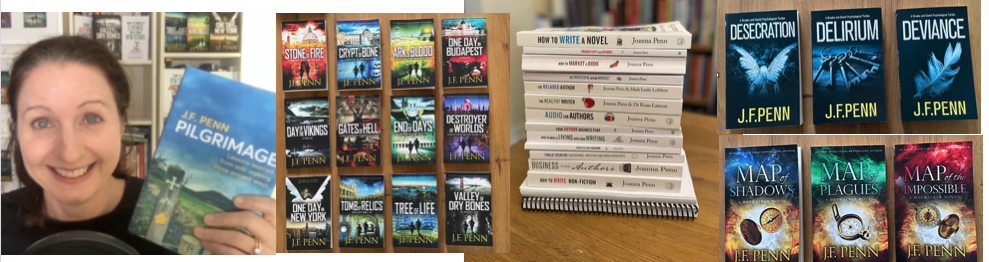
Joanna Penn writes non-fiction for authors and is an award-nominated, New York Times and USA Today bestselling thriller and dark fantasy author as J.F. Penn. She has sold almost a million books across 169 countries and 5 languages. She’s also an award-winning podcaster, creative entrepreneur, and international professional speaker. Her latest book is Pilgrimage: Lessons Learned from Solo Walking Three Ancient Ways.
You can listen above or on your favorite podcast app or read the notes and links below. Here are the highlights and the full transcript is below.
Show Notes
Acknowledge the risks and understand the human response to change
How generative AI has made me re-examine my self-definition
Adopt an AI-curious attitude
What is an AI-Assisted Artisan Author (or A4 for short)?
Create beautiful books and products
Double down on being human
Write the books only you can write and include personal elements that can only come from you
Foster connection and community with other humans
Sell direct so readers connect you, the human, with your books (and other products)
I am an optimist and AI-positive, but I also acknowledge the many questions and issues humanity must work through. There are risks and dangers associated with AI, in the same way that there are with other transformative tools that humanity has developed, and many smart people are working on how to figure out the way ahead.
Fire, electricity, and indeed the internet have huge benefits — and can also destroy lives. But we have adapted and they are an essential part of modern life. Do youwant to live without fire, electricity, or the internet? These are Tools and Weapons: The Promise and Peril of the Digital Age, as covered by Brad Smith in his book, written before the emergence of generative AI.
Yes, there are risks — but there are also incredible opportunities.
I focus on creativity, specifically writing here, but if you research any sector right now, you will see incredible potential emerging with AI tools.
Let’s face it, things are not all rosy and wonderful right now. Humanity has some huge challenges and we could use the help to solve issues that are way too complex for us to figure out. For example, DeepMind’s Alpha Fold is revolutionizing biology, which in turn will accelerate solutions for healthcare issues; and there are many applications for AI in helping to mitigate or even solve climate change [BCG], as well as re-imagine education [UNESCO] and other industries. Pick an area you’re interested in and research how AI is being investigated for future developments.
Of course, there are also legal ramifications around fair use, copyright, and plagiarism, which may take years to work through. I covered these in more detail recently in my interview with intellectual property lawyer, Kathryn Goldman. But technology always emerges ahead of regulation, and the latter will come, in the same way that laws around driving and internet safety emerged after those technologies started to be used more widely.
People always resist technology. That is human nature.
In Build for Tomorrow, Jason Feifer gives many examples of how people have reacted to change. Bicycles were considered damaging to society, and books were considered dangerous for women. US Founding Father Thomas Jefferson even said that novels were “poison [that] infects the mind.”
Cars were known as ‘devil wagons,’ and “people on the side of the streets started throwing rocks at [those in cars]. Oftentimes, bystanders would yell, ‘Get a horse!’”
In the creative sphere, Feifer reports that musicians initially resisted recorded music, seeing it as a threat to their live performances, but then pivoted into embracing it when they began to make money from recordings. As I write this in May 2023, there is controversy over Heart on my Sleeve, a viral hit song created with the AI-synthed voices of two human artists, with debates over the ramifications for copyright and fair use legal frameworks [The Verge].
The development of photography might be the closest comparison to where writers are now. As The Guardian notes, “For 180 years, people have been asking the question: is photography art?” It uses a machine to capture an image, and you don’t have to learn the skills of drawing or painting with a brush to create a finished picture. Some considered photography cheating and unfair on those who take longer to create by hand. Since anyone can do it, it’s essentially worthless, and it certainly can’t be considered art.
But now, of course, photography is considered an art form and people pay for beautiful photos to put on their walls. They visit galleries and exhibitions to see photos, and they buy photobooks and prints. The skill in photography is the choice of subject, the expert use of both the camera as a tool and the subsequent post-processing software, and the deeper human meaning behind the image.
Obviously, some photos are not art. Some are functional, some are just for fun, some are personal, many are worthless. Nevertheless, photography remains and the argument that it’s cheating and unfair to those who paint or draw by hand has largely subsided.
Technology moves on, and you get to choose how best to achieve your creative vision by utilising new tools, or remaining with existing methods.
But I know this goes deeper than semantics about what art is or is not. There is much more at stake.
How generative AI has made me re-examine my self-definition
When people ask what I do, I say, “I’m an author and a podcaster.” I write books and I record and publish audio, although I also do some professional speaking and teaching as well. Enough people pay me through multiple streams of income that I can make a living this way (thank you!) and I have been a full-time author entrepreneur since 2011.
This self-definition has worked for me — until just over a month ago, in March 2023, when Open AI released GPT4 (in the paid version of ChatGPT).
But when I started co-writing with GPT4 (and it really does feel like co-writing), I had a moment of reckoning.
It is a step change from what has come before.
Based on my ideas and my structured prompting and using my own J.F. Pennfiction as examples to guide voice and tone, I was able to output words much faster than I could write them myself. I was so engrossed in the story as I prompted and GPT4 generated, that I enjoyed the experience far more than writing alone. It was so much fun that I was desperate to get back to the page to continue turning what was in my head into reality.
“The most impressive thing about Chat is the most difficult thing for any writer: the ability to spin out words. To do the work. With Chat, paragraphs pour out like rain.”
Of course, a rain of paragraphs, and thousands of coherent words, does not make a story that readers will love, or an engaging non-fiction book. A lot more goes into the process of crafting a finished book. But ‘outputting words’ has always been an important part of the job and what is a writer if not someone who can turn thoughts into words on a page by typing or dictating or hand-writing?
The problem is how we have defined ourselves — and that needs to change in order to move forward.
As Jason Feifer says in Build for Tomorrow, “We are not what we do. We are why we do it.”
I spent some time reassessing my self-definition, and perhaps this approach might help you too.
I help writers and authors with my non-fiction books, courses, speaking, and my podcast as Joanna Penn. My mission at The Creative Penn has always been to empower authors with the knowledge they need to make decisions about their career, to write and publish and reach readers in a more effective way. I want to be useful and I have always loved reading self-help. Early on, I wanted to be the introverted British Tony Robbins!
The Creative Penn Podcast has now been downloaded over 8.5 million times across 228 countries and I have wonderful Patrons who support the show, and people often email me or tweet me or leave a comment to say how much the show has helped them. Many of you have also said that you tune in for my introduction just as much as the interviews, and find my personal take on the industry useful.
While text and audio generated by AI can certainly help you with practical tips and information on writing craft and business, it cannot bring my personal experience or share the emotional rollercoaster that is the reality of being a human author.
My recent midlife memoir, Pilgrimage: Lessons Learned from Solo Walking Three Ancient Ways, is an even better example of a book that cannot be replicated by AI. The words could be duplicated, for sure, but it’s going to be a long time before an AI walks the Camino de Santiago and shares that emotional experience in such a personal fashion!
What about my fiction as J.F. Penn?
I write thrillers, dark fantasy, and crime. But that is not enough.
Plenty of other human authors can deliver books in these genres, and even if you don’t believe AI can do this now, then check out AutoGPT and generative story apps and consider where we will be in a few years.
AI tools can absolutely do that. And if you don’t agree that AI tools can do this now, how about in a year or two years’ time?
Why write fiction then, if readers can get their stories elsewhere?
You’re a writer. You know why! We can’t help ourselves.
Writing is how I figure out what I think.
For non-fiction, it’s what I think about the more practical things, and in my fiction and memoir, it’s the deeper aspects and fundamental questions of life. My fiction has underlying themes of good vs. evil, memento mori (remember, you will die), and whether there is more than just this physical realm (Is there a God? What about demons and angels? What lies on the other side of the veil?)
I’m writing this article because I need to work out my approach to co-creating with AI tools and figure out the next steps in my author career. Sharing my words as I work through this might help you.
I write fiction as I have this constant flow of story ideas. As I walk through the world, my mind constantly spins off into fantastic adventures and dark corridors that I want to get onto the page and into the world. I am overflowing with story ideas that I have yet to share and more arrive every day. Some of the stories that make it into book form touch other people and provoke deeper thoughts, or at least an escape for a while.
At heart, I write fiction for the old me. The Jo Penn who worked a corporate job for over a decade and who read thrillers and crime and dark fantasy to escape a job she hated. I read on the commuter train every morning, with lunch most days and on the way home as well as in bed every night. I still read fiction every day for pleasure and fun and escape in a different way, but back then, it was my lifeline.
So hell yeah, I’m going to keep writing — but since I intend to use AI assistance across my creative and business processes, I need to shift my idea of what the job of an author is.
The latter half of the definition works perfectly if you want to embrace AI-assistance. You can use AI tools through the creative process, with your ideas as the origin of the story or the non-fiction book, your hand-crafting through multiple prompting layers, your guidance and editing shaping the final version of whatever you want to create.
So yes, I’m an author and a podcaster — but I am not someone who just outputs words in text or audio format. It is the purpose behind the words that matter and the connection I make with other humans that has an impact.
As Joanna Penn, I help writers with inspiration and information based on my human experience as an author. As J.F. Penn, I help readers and listeners escape their lives for a time into a world of imagination, and explore the deeper aspects of human life through my themes.
If you’re still with me, and want to do this too, how can we move forward?
Adopt an AI-curious attitude
Too many people are making pronouncements about AI in the creative sphere without trying the tools — or without trying them again, since there are developments every day and the tools are changing and improving at high speed. An opinion you held last week may now shift based on new developments, so question and test your assumptions.
Too many people are stuck in panic and fear and/or avoidance — which I completely understand as I have had those feelings too — but we need to move forward into curiosity and adaptation, as generative AI is not going back in the box.
Every week more companies roll out these tools in workplaces around the world. Just look at the pace Microsoft is releasing OpenAI tools into their Office products, and yes, that includes MS Word, which many authors use for writing. This is driving acceptance and awareness of AI tools in the workplace far faster than previous product iterations.
The biggest tech companies in the world — Microsoft, Google, Amazon, and Meta — are rolling out generative AI tools for creativity, search, and office admin functions.
Even if the popular tools we use right now are shut down because of various legal cases over fair use and copyright, others will emerge built on top of new models created from appropriately licensed work.
For example, if you don’t want to use Midjourney because you’re concerned about its dataset, then check out Adobe Firefly, trained on Adobe’s copyrighted works. Since the tool is integrated with Photoshop, many book cover designers will soon be using it.
If you don’t want to use GPT4, then it won’t be long until you can fine tune a model built with proprietary data on Amazon’s AWS Bedrock using the Titan model. Since it only needs 20 examples to fine-tune the Foundation Model, even individual authors could use it with a backlist. Imagine what a publishing company could do with thousands of genre-specific books.
You are already AI-assisted and you already use AI tools as part of your daily life and your author business.
If you use Grammarly or ProWritingAid for aspects of editing, Google for research or Maps for navigation or email with auto-anti-spam, Amazon for publishing or advertising or shopping, Facebook or TikTok or Twitter for social media, Spotify for music discovery, or Netflix for TV, you are using AI-assisted platforms and tools. Even if you only use Microsoft Word, it will soon be enhanced by generative AI with Co-Pilot.
You can go back to writing by hand on paper and avoid AI altogether, or you can take a breath and follow your curiosity.
Experiment.
Try out the tools (many of them are free or cheap) and see how they might help you create what you could only dream of before.
If you are AI-positive or at least AI-curious, check out the Facebook groups AI Writing for Authors, and AI Art for Authors, which are full of great tips and tricks and recommendations for various tools and prompts to get started.
This is the beginning of a new form of creativity, and everyone is finding their own way. We are all new at this.
Try things out and find your own process, in the same way as writers have always figured out their own way of doing things. You can learn from others — and people change their process every day right now as new options emerge! — but in the end, it’s your brain, your ideas, and your creative vision.
It’s also a great way to continue learning the craft of writing. In the same way that experienced artists construct the best prompts for AI art —
The better you are at writing, the more deeply you understand the craft, the more you can prompt the AI tools into what you want to generate — and of course, edit the output with your creative vision in mind.
While you experiment, I recommend that you don’t use other author or artist names in your prompts, whether for words, images, music, or voice. While this may not legally infringe on the originator’s intellectual property rights for doing so at the moment since the law is not certain, it crosses an ethical line (in my opinion) and you are far more likely to plagiarise if you use someone else’s name in a prompt. These are powerful tools, so let’s use them responsibly.
You want to create something that is uniquely you, so use your writing to prompt and fine-tune. You can use samples of your writing in your prompts even if you have never published anything, so just give it a go.
What is an AI-Assisted Artisan Author (or A4 for short)?
An artisan can be defined as “a worker in a skilled trade, especially one that involves making things by hand,” or one made “in a traditional or non-mechanical way using high-quality ingredients.” [Oxford English Dictionary]
I tried to find a better word than artisan and no doubt some will argue with my use of the term, but I think it works because I intend to personally oversee and hand-craft my books and products while also incorporating AI writing and creativity tools into my process.
Some will choose to use AI tools in a high-production model, but that is not the only approach.
I aim to produce books of higher quality and work with the tools to go deeper into my themes and write in an ever more personal way than I have done before. As Anais Nin said, “If you do not breathe through writing, if you do not cry out in writing, or sing in writing, then don't write, because our culture has no use for it.”
Because it’s not about the production of words.
It’s not about the paragraphs pouring out like rain.
“A bright line is being drawn between creators today. Some think the job is to create content. Others know the job is to create connect. When you learn to matter more, you need to beg for attention less. Keep making what matters.”
So how can we do this?
Double down on being human
I often talk about this as a concept, but what are some ways you can practically demonstrate your humanity even as you use AI tools as part of your process?
Write the books only you can write and include personal elements that can only come from you
In Futureproof, Kevin Roose explains more about how he leaves handprints in his work as a reporter.
“I start every reporting assignment by figuring out how I can put my unique stamp on it, and not have it feel like a generic story that any other reporter (or any piece of AI software) could have written.”
As authors facing the same question — If a bot can write this book, what’s the point?
The goal is to make every book resonate with your humanity even as you use AI tools as part of your creative and business processes.
If you’re writing non-fiction, fill it with personal stories, not just tips that could come from anyone. If you’re writing fiction, explore the personal themes that keep you awake at night, or delight you and make you laugh, or help you escape into another world and inspire a sense of wonder. It’s a call to center your humanity and put more of yourself into your work.
I know how hard this is. Fear of judgment is my deepest struggle — with my books, with my podcast, and especially on controversial topics like this!
I was scared to publish my darkest book, Desecration, for fear of what people might think of my darker side. I was worried when I published The Successful Author Mindset, as I shared snippets from my diaries around the reality of being a writer.
Even after 15 years of being an author, I was terrified of publishing Pilgrimage as it laid bare my midlife depression, and thoughts I hadn’t even shared with my husband, let alone the wider world.
But that’s what we need to dial into.
AI tools can generate unlimited words in very little time, and never tire, never stop. But that doesn’t matter.
Your books are your ideas. Your prompts. Your curation. Your editing.
Your creative direction.
However you create — with or without AI tools — it’s more important than ever to find your voice and reach readers as one human connecting with another.
Create beautiful books and products
While digital products (ebooks, audiobooks, online courses) will continue to be important, generative AI will result in digital abundance, which will drive revenue down as there is so much supply.
Scarcity, therefore, becomes ever more important, and as such, I am excited about creating beautiful physical products (alongside the usual formats for my books).
While I read every day in ebook and audiobook formats, my bookshelves are full of beautiful hardbacks that I spend more money on. My most expensive book is an oversize edition with full-color images of Carl Jung’s The Red Book (which partially inspired Stone of Fire). Others include Death: A Graveside Companion, Heavenly Bodies by Paul Koudounaris, Dark Tourism by Rebecca Bathory, Lost Cities Ancient Tombs, and Anatomica: The Exquisite and Unsettling Art of Human Anatomy. If you like the sound of these, you might enjoy my fiction as J.F. Penn. Yes, I am a dark little soul!
I am proud of all my books, but this is the first physical product I have made that I truly love. While the content of the memoir is available in all the usual formats in all the usual places, this premium physical product is both an expression of my desire to make something beautiful for a book of my heart — and also makes me a decent profit. This satisfies my artistic and my business sides and helps my books stand out.
I intend to do more beautiful books and I have loads of ideas about future projects, potentially working with AI-assisted artists as well as my existing team. I will still publish all the usual formats on the usual platforms, but I will also be doing more special projects on Kickstarter and selling direct-only products from my store, CreativePennBooks.com
In this way, I can “Leave handprints,” as Kevin Roose suggests in Futureproof: 9 Rules for Humans in the Age of Automation. “What will make us stand out is not how hard we labor, but how much of ourselves shows up in the final product. In other words, elbow grease is out. Handprints are in.”
[I also recommend Kevin’s podcast, Hard Fork, with Casey Newton, which offers weekly insights into AI developments.]
Foster connection and community with other humans
You can also use AI tools for marketing, and even some of those authors who are adamant about not writing with AI are using it for social media and marketing copy, character images, advertising, and more.
But even as we use the tools, we have to ‘leave handprints.’
Share aspects of your personal life that would be hard to replicate consistently over time by a machine. Yes, there are deep fake photos and there are photo-quality AI images of people who don’t exist, but you are real, so share real photos on social media or your website, preferably of your face so people can see you. In this vein, human me will still present this podcast until I tell you otherwise, even though my voice double gets better every week.
Of course, you need to protect your boundaries. I don’t share pictures of my husband on social media, but I share enough pictures of random things regularly that you know I am a real person with a varied life. It’s not just all about branding, or on-message photos like the kind generated by fake media purely for sales purposes.
Be a human with a physical body
Attend events in person so you can meet and connect with other humans. I know this is hard. I’m an introvert with a touch of social anxiety. I’m overly sensitive to sound and light, and find crowds and noise difficult. After 20Books Seville recently, I spent a day in bed recovering in silence and darkness and then I had to leave London Book Fair early, spending another day in bed, this time with a headache that completely shut me down. [Thanks to everyone who sent me tips on how to manage my energy better!]
This kind of person-to-person connection is critical, and increasingly so as the digital world becomes even more pervasive. People do business with people they know, like, and trust.
After 15 years of building a digital, scalable, online business, I am now searching for ways to be more physical, immediate, transitory, and in-person. Less scalable, more personal.
Of course, it can be expensive and impractical to travel to events and conferences, so try arranging a meet-up locally with other authors, or organize a reader event at a local library. Or consider how else you could do something in person. What might intersect with your books/stories/world?
Sell direct so readers connect you, the human, with your books (and other products)
When you choose to buy direct instead of through a big brand store, you connect with the creator.
When you sell direct, you have a closer relationship with the buyer. You get paid more quickly and you can email them over time, fostering the relationship — and yes, encouraging more sales!
The same happens with Kickstarter or other crowdfunding platforms. You connect with the author/creator more directly and you are choosing to help them create and make more of a profit.
You can buy my books in all formats at www.CreativePennBooks.com (or at your favorite online store, or order at your library or local bookshop).
These are just some aspects of doubling down on being human, and I’m sure more will emerge as this industry changes and shifts over time.
As Jason Feifer says in Build for Tomorrow:
“Do not panic. Do not focus on what is lost. Focus instead on what can be gained.”
Fifteen years ago, I embraced a new form of publishing, as one of the first generation of indie authors to use ebooks and digital audio as well as print on demand.
I originally self-published back in the days when it was seen as ‘vanity’ and a bad decision that would destroy your reputation. Now it’s seen as a valid choice for business-minded authors who want to write and publish the books they choose, own and control their intellectual property, connect with readers directly, and make a full-time living as an author.
I didn’t know it would turn out this way when I first self-published in early 2008, just a few months after the Kindle and the iPhone launched in late 2007. All I knew was that I wanted to join this exciting movement full of authors experimenting and forging their own path on the back of a new wave of technology.
I’ve experimented and tried new things along the way, pivoted and shifted, and grown since then — and I am still here, still writing, still creating, still running my own business.
“When individuals are at their most successful, we are also at our most vulnerable. We become so preoccupied with optimizing, enjoying, and defending the competitive advantage that made us successful today that we neglect to prepare for tomorrow.”
Indie authors are successful right now, but the old model is shifting, and I need to change in order to be successful in the next 15 years of my author career. I am only 48. I have a lot of life left in me (touch wood!)
At 20BooksSeville recently, someone described me as one of the ‘old guard’ of indie because I have been doing this for so long. I’m grateful for the last 15 years, but I don’t want to be the ‘old guard.' I want to be in the vanguard of this new exciting movement full of authors and creators forging their path on the back of this next wave of technology.
I’m experimenting and playing and trying new things. I’m pushing the boundaries of my existing creative process and slowly, I am shifting into being an AI-Assisted Artisan Author. How about you?
Let me know any questions or thoughts in the comments, or Contact Me here, and please be gentle. We are all still working this out together!