Shhhh! The British Library is in crisis — and the staff are revolting
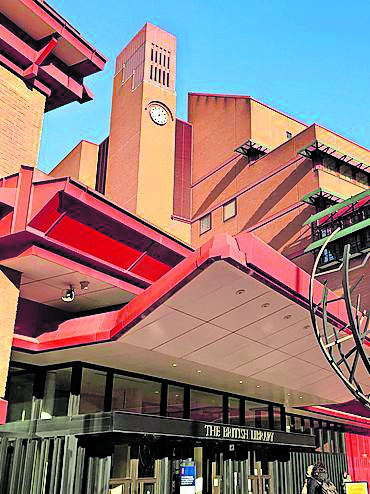
How are things these days in the academy for secret police, as King Charles famously described the British Library when Colin St John Wilson’s building was new in 1998? Well, the building itself — a vast, impassive modernist riposte to the gothic gargoyles and spires of George Gilbert Scott’s St Pancras station next door — is doing fine. It’s now even grade I listed, which must amuse King Charles no end.
But inside those bland red-brick bunkers? The BL’s regular users and staff live in a world of words — perhaps a trillion of them contained in 14 million books and 150 million other items. So they have plenty of vocabulary all around them. Yet it’s amazing how the same handful of adjectives keep cropping up when insiders describe the present state of affairs. Disastrous, dysfunctional and demoralising are favourites. And since the BL gets £136 million of taxpayers’ money each year, that should concern us all, not just the academics who use it most often. What’s going on?
The answer next week will be “not a lot” because 300 of the BL’s staff will be out on strike, for the second time this autumn. Their grievance? Partly it’s about their pay, which is low anyway and certainly hasn’t kept pace with inflation, or (according to their union, the PCS) with the inflated salaries and bonuses awarded to the BL’s executives.
It’s also about the debilitating stress on staff caused by a crippling cyberattack. That was inflicted in October 2023 by Rhysida, a ransomware gang believed to be based in former Soviet republics. Rhysida hacked into the BL’s computer systems then demanded a £600,000 ransom. As a government-funded public body the BL was not permitted to pay that but there’s no denying that giving in to the criminals’ demands (as a lot of private corporations are said to do) would have been a lot cheaper than repairing the damage then inflicted by the gang — a massive technological rebuilding task that is believed to have cost £7 million already.
But the main trouble is that, two years on, some damage is still not repaired. We all applaud when great libraries and museums say they are “digitising their collections”. It suggests that amazing intellectual riches are being made available to everyone at the press of a button. And so they are. The downside is that when “computer says no” — a spectacularly big no, in this case — the entire institution breaks down. With online catalogues unavailable, book-retrieval systems unusable and archives unreachable, the BL was effectively paralysed.
At first people were sympathetic, particularly as the library bravely published a frank and detailed admission of what went wrong, something rarely done by private companies that have been hacked. But as the weeks of disruption turned into months and now years, the army of scholars who depend on the BL for their research have become increasingly angry and the staff (many of whom had their personal information dumped onto the dark web) have become exhausted by trying to do manually some of the thousands of tasks that the computers are supposed to do.
A crippling cyberattack left the staff in disarray
In short, the place is in disarray. And the reason this has gone on for so long without anyone outside the library community caring very much says a lot about modern Britain. It’s not that we don’t, as a nation, value research. Medical breakthroughs, scientific advances, the world-changing claims of the AI pioneers, the jaw-dropping investments of the tech bros — these are constantly in the news. But what happens at the BL is, mostly, the wrong kind of research. It’s about the dull old humanities, not the cutting-edge sciences. It mostly looks backwards, not forwards. So it’s regarded, not least by our political leaders, as a backwater.
What, though, of the BL’s leadership? Another tale of woe. A former BBC exec called Roly Keating ran the BL for 12 years and it was on his watch that the cyberattack happened. He later admitted that the BL had failed to invest enough in IT systems and staff. Nevertheless he accepted a £10,000-plus bonus in the year after the attack, then resigned.
His successor, Rebecca Lawrence, was previously chief executive of the Crown Prosecution Service, which she left after bringing a case against the CPS for age and sex discrimination. She arrived at the BL on January 2 this year and resigned on November 3 — no public reason given. Great appointment.
Now the library is being led on an “interim” basis by one of its board members, Jeremy Silver. He at least has a background in digital technology as the former chief executive of Digital Catapult, a government-funded research lab. But he will need to deal with the disgruntled humans under his command before he gets to grips with the outdated technology.
Bizarrely all this trouble is happening alongside extraordinary announcements about the BL’s future. It has entered into partnership with the Japanese developer Mitsui Fudosan (which has a stake in several high-profile developments across London) to build a huge £1.1 billion extension to the library by 2032. The idea is that the site (north of the library) will house commercial life-science and tech companies as well as new entrances, foyers and exhibition spaces for the BL.
All of which is exciting but worrying. Did nurturing this ambitious plan distract the BL’s board and management at the very time when the cyberattack required their total attention? Will raising the hundreds of millions of pounds of private finance and philanthropy required for the extension have implications for less glamorous parts of the BL’s operations (for example, being a competent library)? And isn’t the huge emphasis on science and technology in the new development an ominous indication that the BL is acquiescing to the general anti-humanities drift in British culture?
Let’s hope the interim chief executive, or his successor, lasts long enough to come up with reassuring answers.


No comments:
Post a Comment